












What's the Difference Between a Bull & Bear Market?
 Phil Town
I sometimes get asked by investors what is a bull market and what is a bear market. It tends to come up when the market is moving hard in one direction and people want to understand what they are looking at.
Both terms describe the overall direction of the stock market over a sustained period of time. One means prices are rising. The other means prices are falling. But there is a lot more to understand about each one than just the direction, including what causes them, how long they typically last, and what a disciplined investor actually does when each one arrives.
By the end of this page, you will have a clear picture of both. And you will understand why Rule 1 investors think about bull and bear markets very differently than most people do.
[r1-johnsonbox name="Virtual Workshop B"]
What Is a Bull Market?
A bull market is a sustained rise in stock prices, typically defined as a gain of 20% or more from recent lows. Bull markets are defined by the market going up aggressively over a period of time. As the market starts to rise, there becomes more and more greed in the stock market. You see more and more people thinking, "Oh yeah, let's put money into the market because it's going up."
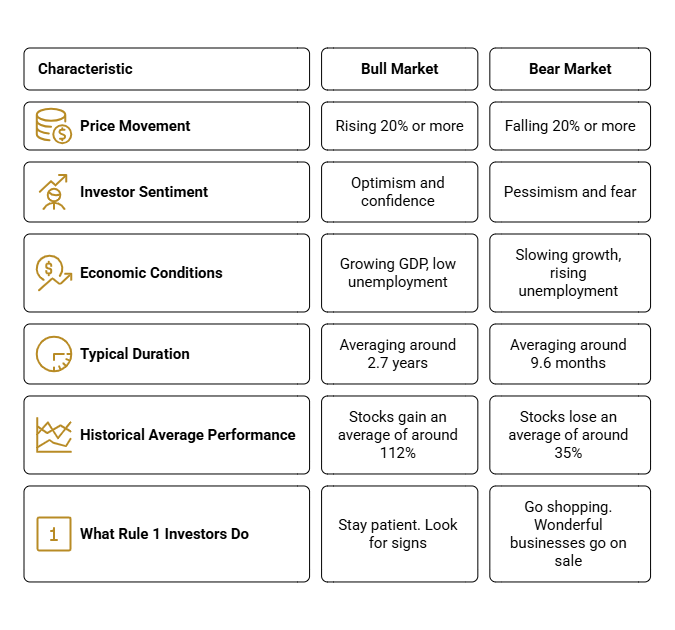
And honestly, that excitement makes sense. Historically, bull markets have averaged around 2.7 years, and stocks have gained an average of around 112% during that time. Real money gets made in a bull market.
But here is the thing. The longer it runs, the more people start confusing a rising price with a great investment. Those are two very different things. And that confusion is where most investors get into trouble.
The term comes from the way a bull attacks. It thrusts its horns upward. In a bull market, everything feels like it is heading in one direction, and most investors feel pretty good about themselves. That is usually right when you want to start paying closer attention.
What Causes a Bull Market?
Though a wide range of different factors contributes to a bull market, the two largest are usually:
A strong economy
High employment levels across the board
I would add a few more to that list:
Rising corporate earnings, which give investors real reasons to believe companies are worth more
Low interest rates, which make it cheaper for businesses to borrow and make stocks more attractive than bonds
Growing consumer and business confidence, which keeps spending up and momentum going
Bull markets do not need a perfect economy to keep running. They just need things to be broadly improving and investors feeling good enough to keep putting money in. That combination can last for years, even when the underlying numbers start telling a different story.
In my experience, bull markets are when most investors feel the best about being in the market. They are also when the most costly mistakes get made. When everything is going up, it is easy to think you are brilliant. I have seen it happen a lot. The key is knowing the difference between a rising price and real value. We will get into exactly how to do that.
What Is a Bear Market?
The bear market definition is exactly the opposite of a bull market. A bear market is a sustained decline in stock prices of 20% or more from recent highs, lasting at least two months. It's a market where quarter after quarter the market is moving down about 20 percent. That signals a bear market, and when that happens people start to get really scared about putting money into the stock market. That's because they don't know how to invest Rule 1 style.
Prices are not just dipping. They are falling broadly and steadily. Fear spreads. Selling accelerates. And a lot of people exit the market at exactly the wrong time.
Why Is It Called a Bear Market?
Interestingly, a bear market is named for the way that this particular animal attacks its victims. A bear swipes downward during an attack, thus becoming a metaphor for market activity under these conditions.

Source: sketchplanations.com
What Causes a Bear Market?
Bear markets do not always start the same way. Common triggers include:
Economic slowdowns or recession fears, where growth stalls and corporate profits shrink
Rising interest rates, which make borrowing more expensive and squeeze profit margins
Major global shocks, like a pandemic or financial crisis, that shake confidence all at once
Self-reinforcing fear. Selling drives prices lower, which causes more fear, which causes more selling
The cause matters less than you think. What matters is knowing how to respond.
How Long Do Bear Markets Last?
The average bear market has lasted around 9.6 months based on historical data going back to 1928. The median runs closer to 19 months, depending on how you measure it.
The shortest on record was the 2020 COVID selloff, roughly one month. The longest stretched nearly three years during the Great Depression.
Bull markets have historically lasted significantly longer and recovered all the losses. Bear markets feel long when you are in them. In the historical record, they are the shorter part of the cycle.
Bear Market History
Since 1928, there have been 27 bear markets in the S&P 500. The average loss has been around 35%. Every single one ended. And the bull markets that followed recovered the losses.
Bear markets happen roughly every three to five years on average. They are a normal part of the cycle, not a sign something has permanently broken.
Bear Market Examples
One of the most famous examples of a bear market takes the form of the 1987 market crash, which saw a 29.6% drop that lasted roughly three months.
The 2008-2009 financial crisis saw the S&P 500 lose roughly 50% of its value over approximately 17 months. It felt catastrophic at the time. For investors who knew what they owned and held their nerve, it turned out to be one of the best buying opportunities of their lifetime.
The 2020 COVID selloff dropped the market around 34% in a matter of weeks, then recovered faster than almost anyone expected.
Each of these felt like the end of the world at that moment. In hindsight, each one was a sale on wonderful businesses. I will show you exactly how to take advantage of that.
Bull vs. Bear Market: Key Differences
Most people think of bull and bear markets as opposites. They are, but it helps to see them side by side. Here is how they compare across the things that actually matter to an investor. The last row is the one most investors never think about. Understanding what a bull and bear market are is useful. Knowing exactly what to do in each one is what changes your results.
Bear Market vs. Market Correction: What's the Difference?
A market correction is a drop of 10% or more from recent highs. A bear market is a drop of 20% or more. Both involve falling prices. But they are not the same thing, and they do not call for the same response.
Corrections are common. They happen regularly, even inside bull markets. The market dips, people get nervous, and then it recovers. That is normal market behavior. A correction is not a crisis.
A bear market is deeper, broader, and longer. Prices are falling across the board, fear is driving the decisions, and the decline is sustained over months, not weeks.
Here is the practical difference for a Rule 1 investor. A correction is not a signal to go shopping at scale. Prices are down, but they may not be down enough to hit the Margin of Safety on a wonderful business. A bear market is a different story. That is when prices can drop far enough to create real buying opportunities on companies worth owning.
Knowing which one you are in matters. Panicking during a correction is one of the most common and costly mistakes investors make.
Why Markets Behave This Way: Meet Mr. Market
I want to tell you about something that completely changed the way I see the market. Once you understand this, bull and bear markets stop feeling random. They start making a lot of sense.
The idea comes from Benjamin Graham, Warren Buffett's mentor and the man who laid the intellectual foundation for everything I teach. Graham introduced a concept called Mr. Market.
Here is how it works. Imagine you own a share in a private business. You have a partner in that business named Mr. Market. Every single day, Mr. Market shows up and offers to either buy your share of the business or sell you his share. He is always willing to make a deal. That part is great.
The catch is that Mr. Market gets to name the price. And his prices are all over the place.
Some days Mr. Market is absolutely euphoric. He is convinced everything is going wonderfully, the future looks incredible, and he names a sky-high price for his share. Other days, he is convinced the world is ending. He sees nothing but doom ahead and he will practically give his share away.
Now here is the thing. The business has not actually changed between those two days. The same customers, the same products, the same fundamentals. What changed is Mr. Market's mood.
A bull market is Mr. Market in full euphoria. Prices are soaring, optimism is everywhere, and everyone wants in. A bear market is Mr. Market at his most despairing. Prices are collapsing, fear is everywhere, and wonderful businesses are suddenly available at steep discounts.
The insight that Graham gave us, and that Buffett has used his entire career, is this: Mr. Market is your servant, not your guide. His prices are information. They are not instructions. You are never obligated to act on what he offers. If his price is too high, you wait. If his price is absurdly low on a business you have done your homework on, you buy.
That shift, from reacting to prices to evaluating businesses, is what Rule 1 investing is built on. And it is what makes a bear market look completely different to a Rule 1 investor than it does to everyone else.
For more on the principles behind this approach, see Warren Buffett Quotes on Investing and our Value Investing Guide.
How Rule 1 Investors Approach Bull and Bear Markets
As a Rule 1 investor, I act opposite of the investing public when it comes to bull and bear markets, and capitalize on their emotions by finding quality stocks at low prices during bear markets and selling during bull markets when they've regained their value.
Here is the logic behind that, because it is not contrarianism. It is the rational response to understanding that price and value are two different things.
Most investors buy during bull markets. Prices are rising, confidence is high, and everyone around them seems to be making money. So they pile in. Then a bear market arrives, prices drop, fear spreads, and those same investors sell. They buy high and sell low. Not because they are foolish. Because they are following their emotions instead of a framework.
The key thing to understand in Rule 1 Investing is that I move almost exactly the opposite of the way most people are moving in the marketplace. I take advantage of the bulls and bears.
The investors who get hurt in bear markets are the ones who do not know what they own. If you do not know what a business is worth, a falling price feels like a loss with no end in sight. If you do know what it is worth, a falling price is an invitation.
For more on the events that create these buying opportunities, see Events That Cause Stock Prices to Go on Sale. And if you want to understand why trying to time the market without a framework is a losing game, read our guide on Market Timing.
The Key to Making This Work: Knowing What a Business Is Worth
So how do you actually know what a business is worth?
That is the whole game.
In Rule 1, we calculate what I call the Sticker Price. The Sticker Price is the fair value of a wonderful business. Not what Mr. Market is charging for it today. What it is actually worth based on the money it is going to make for its owners over time.
Once you have the Sticker Price, the market cycle stops being a mystery. It becomes a set of signals.
In a bear market:
I am watching for one thing. The price of a wonderful business dropping to 50% of its Sticker Price. That is the Margin of Safety. That is when I act.
I am not buying because the market is down. I am buying because I know what the business is worth and Mr. Market is offering it to me at half price.
In a bull market:
I watch for the price to approach or exceed the Sticker Price. That is the signal to consider selling. Not because bull markets are bad, but because when price meets value, the opportunity is gone.
That is what most investors never have: a number.
Without a Sticker Price, every market move is a guessing game. With one, you have a framework. The market cycle becomes a tool, not a threat.
Learning to calculate the Sticker Price is exactly what I teach.
If you want to understand the Margin of Safety in more depth, start here: Margin of Safety. And if you want to run the numbers yourself, the Rule One Toolbox has the calculators that make it straightforward.
[r1-cta-banner name="How to Pick Stocks"]
Should You Buy in a Bear Market?
Rule 1 Investing is about taking advantage of fear and greed. I like to buy when there's fear. In other words, when the market is going down, I love to be a buyer. When the market is going up, I love to be a seller.
And I will tell you, a bear market is one of my favorite things.
Most people see falling prices and run. I see falling prices and start looking at my Watch List. Because when the market drops hard, wonderful businesses go on sale alongside everything else. Mr. Market does not discriminate. He panics across the board.
Think about what happened in 2008 and 2009. The S&P 500 lost roughly 50% of its value. It felt like the end of the world. Investors who knew what they owned and held their nerve walked into one of the greatest buying opportunities of a generation. The same thing happened in 2020. The market dropped around 34% in a matter of weeks. Investors who bought wonderful businesses at deeply discounted prices and stayed patient were rewarded when the market recovered.
Where most people feel really scared or nervous in a bear market, I. It's like going to a flea market and everything is on sale. I get really excited.
Sometimes I get asked, "What if you buy the stock, and it goes down more?"
When I buy, I hope the stock goes down more.
I love to buy more when the stock goes down more. When the stock goes up again, that is when I start to collect the profit.
One important caveat. This only works when you know what you own. Random buying during a bear market is not the Rule 1 approach. Buying a business you do not understand at a price you have not calculated is speculation. What makes this strategy work is the Sticker Price and the Margin of Safety. Those are what tell you whether the drop is a buying opportunity or just a falling knife.
To understand what drives stock prices in the first place, read: What Makes a Stock Go Up or Down. And when you are ready to think about the other side of the trade, start here: When to Sell a Stock.
Frequently Asked Questions
What is the difference between a bull and bear market?
A bull market is a sustained rise in stock prices of 20% or more from recent lows, driven by optimism and economic growth. A bear market is a sustained decline of 20% or more from recent highs, marked by fear and falling confidence. The real difference for an investor is not just the direction of prices. It is what you do about it.
How long do bear markets typically last?
The average bear market has lasted around 9.6 months based on historical data going back to 1928. Some have been as short as one month, like the 2020 COVID selloff. Others have stretched to nearly three years. Understanding stock market cycles helps put this in perspective: bull markets have historically lasted significantly longer than bear markets and have recovered the losses every time.
Is a market correction the same as a bear market?
No. A correction is a drop of 10% or more from recent highs, typically resolving in under two months. A bear market is a drop of 20% or more and lasts longer. Corrections happen regularly, even inside bull markets. They are normal and not a signal to go shopping at scale the way a bear market is.
What is a good bear market investing strategy?
The Rule 1 approach is straightforward: know what your businesses are worth before the bear market arrives. When prices drop to your Margin of Safety, that is when you act. A sound bear market investing strategy is not about reacting to fear. It is about executing a plan you made when prices were calm. The investors who do best in bear markets are the ones who did their homework first.
How should I invest during a bear market?
Knowing how to invest during a bear market starts with knowing what you own. If you have calculated the Sticker Price of wonderful businesses and prices are dropping toward your Margin of Safety, that is the time to buy. If you have not done that work yet, start now. This is not the time to panic or to buy randomly. It is the time to be selective, patient, and disciplined.
Should I sell my stocks during a bear market?
Not if you know what you own and you bought at the right price. Selling during a bear market locks in losses and means you will likely miss the recovery. The investors who get hurt most in bear markets are the ones who sell out of fear, not out of logic. If you bought with a Margin of Safety, a bear market is not a reason to sell. It may actually be a reason to buy more.
Do bear markets always lead to a recession?
No. Many people assume a bear market and a recession always go hand in hand, but they do not. In roughly a quarter of historical bear markets, a recession did not follow. A bear market reflects investor sentiment and falling prices. A recession reflects actual economic contraction. They can happen together, but one does not guarantee the other.
Learn to Invest in Any Market
In a bear market or bull market, I pretty much do exactly the opposite of what everyone else is out there doing. As a Rule 1 investor, I love taking advantage of both.
Knowing the strategy is one thing. Being able to execute it when prices are falling and fear is everywhere is another. The difference is preparation.
The next bear market is coming. The investors who come through it well will already have their Watch List built, their Sticker Prices calculated, and their Margin of Safety prices set.
That is what we build together at the Virtual Investing Workshop. Real businesses. Real calculations. Mentors. A framework you can actually use.
If you want to learn how to invest successfully regardless of how the market is performing, I would like to invite you to join me.
Join the Virtual Investing Workshop
Not ready for the Workshop yet? Start here.
[r1-cta-banner name="Virtual Workshop"]

Phil Town
Phil Town is an investment advisor, hedge fund manager, 3x NY Times Best-Selling Author, ex-Grand Canyon river guide, and former Lieutenant in the US Army Special Forces.