









Can AI Teach You to Invest? Here's What It Gets Right (and Where It Falls Short)
 Phil Town
If you've typed an investing question into ChatGPT and thought, "this is actually pretty good", I get it. I've seen it myself. These tools are impressive. They can explain a concept clearly, summarize a filing, and sound confident doing it. Of course you're curious about whether this is all you need.
There's a big difference between using AI for investing research and actually learning to invest. I learned that distinction the hard way, long before AI existed, when a mentor sat down with me and walked me through how to evaluate a real business.
Reading about it hadn't done it for me. Understanding it conceptually hadn't done it for me. Doing it with someone who could tell me where my thinking was wrong did.
What AI Actually Does Well for Investors
I want to be fair here. AI has real uses in investing, and I would not be doing you any favors by dismissing it.
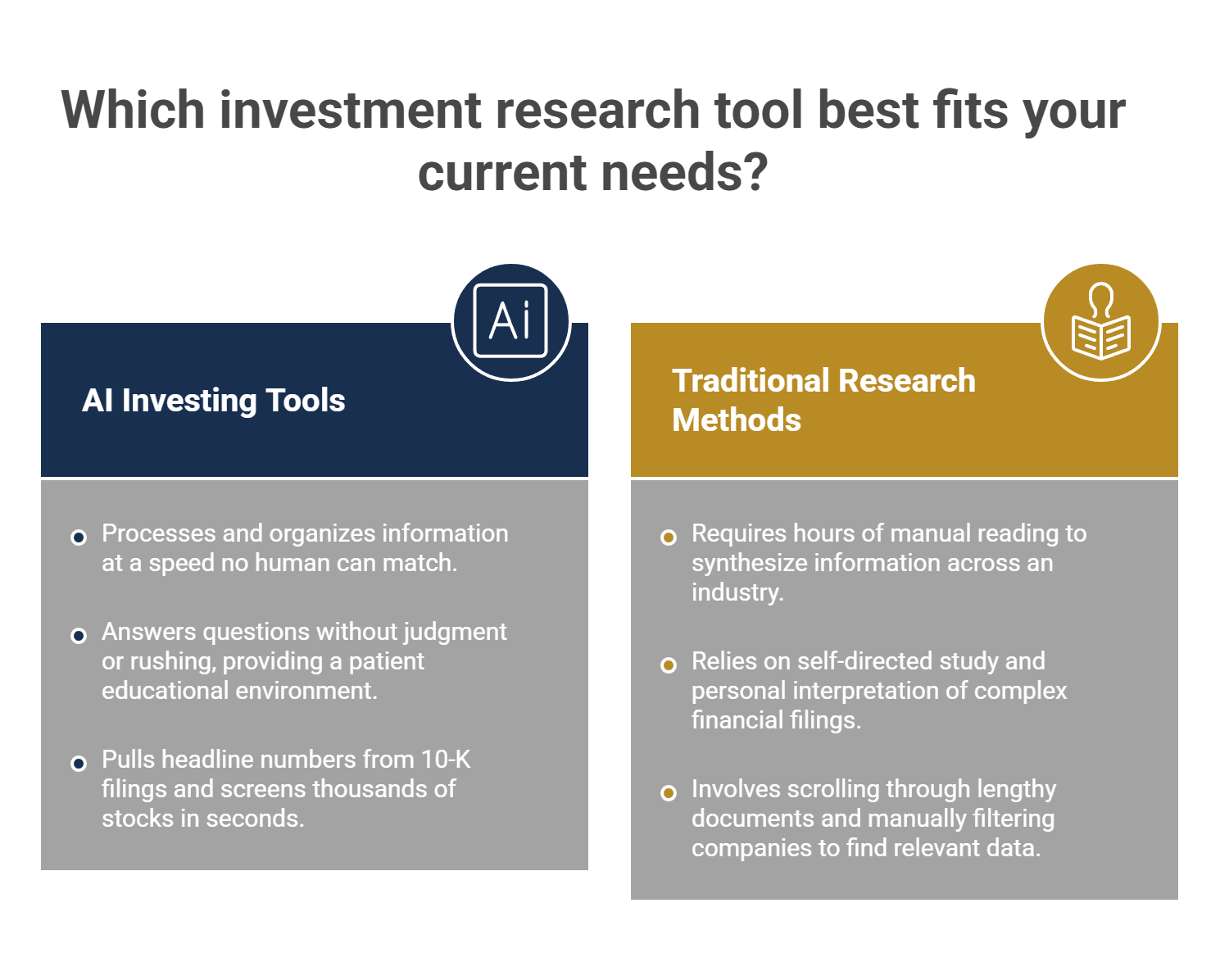
I have spent years watching research tools get faster and better. When I started out, pulling the data you needed on a single business could take days. Free sites like Yahoo Finance and MSN Money changed that, suddenly you could get to the numbers in minutes. As an AI investing tool, AI takes that even further, processing and organizing information at a speed no human can match.
That is genuinely useful.
Here is What AI Does Well
Used as an AI assistant for investment research, AI handles the following reasonably well:
Explaining financial terms and ratios: Ask it what a price-to-earnings ratio means and it will give you a clear, patient answer.
Summarizing earnings reports and financial filings: It can pull the headline numbers from a 10-K faster than you can scroll through one.
Screening stocks by basic criteria: You can filter by sector, size, or general financial metrics across thousands of companies in seconds.
Identifying broad sector trends: It can tell you what is happening across an industry without hours of manual reading.
For someone just getting started, having a tool that will answer your questions without judgment and without rushing you is actually valuable. There is no such thing as a dumb question when you are asking a machine.
Where AI Breaks Down as a Teaching Tool
That is where the good news about AI ends, at least for our purposes. When you move from using AI as a research shortcut to relying on it as an investing education, real problems emerge.
AI Confidently States Things That Are Wrong
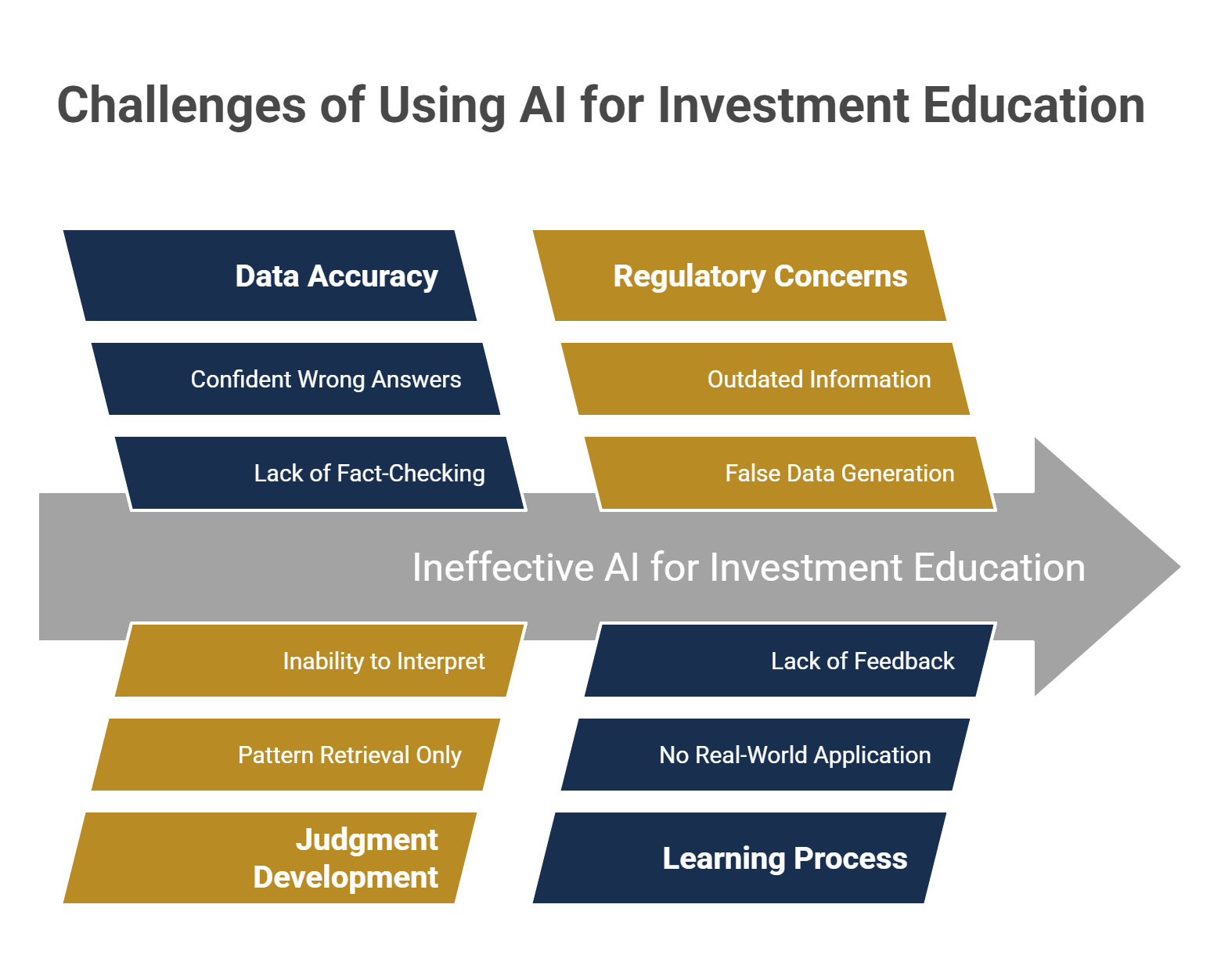
AI language models generate responses based on patterns in data, not on verified facts. That means AI can produce a confident, well-structured answer that is factually wrong with no mechanism to flag the difference between reliable information and a plausible-sounding error.
In most contexts, that is a manageable inconvenience.
In investing, it is a different kind of problem. Acting on incorrect financial data is not a small mistake. It is a capital risk.
This is not just a concern I have. Financial regulators have flagged it directly. The UK's Financial Conduct Authority has publicly warned that general-purpose AI tools can provide outdated or inaccurate information on financial topics and, in some cases, may generate false or misinterpreted data entirely.
Their position is worth noting: these tools are not designed for investment research. They are built to respond to a wide range of prompts, which means they have no reliable way to distinguish a credible financial source from an unreliable one.
That distinction matters enormously when you are evaluating a real business with real money.
AI Retrieves Patterns. It Does Not Develop Judgment.
Even when AI's data is accurate, it cannot teach you how to think about it. That is a fundamentally different skill and the one that actually determines whether you invest well.
Here is a concrete example.
Ask AI to explain Margin of Safety and it will give you a technically correct answer. Margin of Safety means buying a business at a price well below its calculated value paying fifty cents for a dollar's worth of business, so that if your analysis turns out to be imperfect, you are protected.
That is accurate. What AI cannot do is look at a specific business, in a specific market environment, with a specific management team, at a specific price, and tell you whether that Margin of Safety is real.
Because determining that is not a data retrieval task. It requires judgment built from the Four M's framework:
Meaning: Does this business make sense to you as an investor, and are you proud to own it?
Moat: Does it have a durable competitive advantage that protects its future?
Management: Is leadership acting like a long-term owner rather than a short-term operator?
Margin of Safety: Only after the first three are confirmed is the price well below what the business is actually worth?
Each of those assessments requires interpretation, not just information.
When I learned to invest, I did not learn by reading about it on my own. I met someone who took me in and taught me the formula. The principles clicked when I used them under guidance, applied to real businesses, with someone who could tell me where my thinking was off.
That is not a personal quirk. That is how investing judgment develops. Practice, feedback, and real decisions made under real uncertainty are what build the skill. A conversation with a chatbot, however sophisticated, does not replicate that process.
Knowing the Rules Is Not the Same as Applying Them
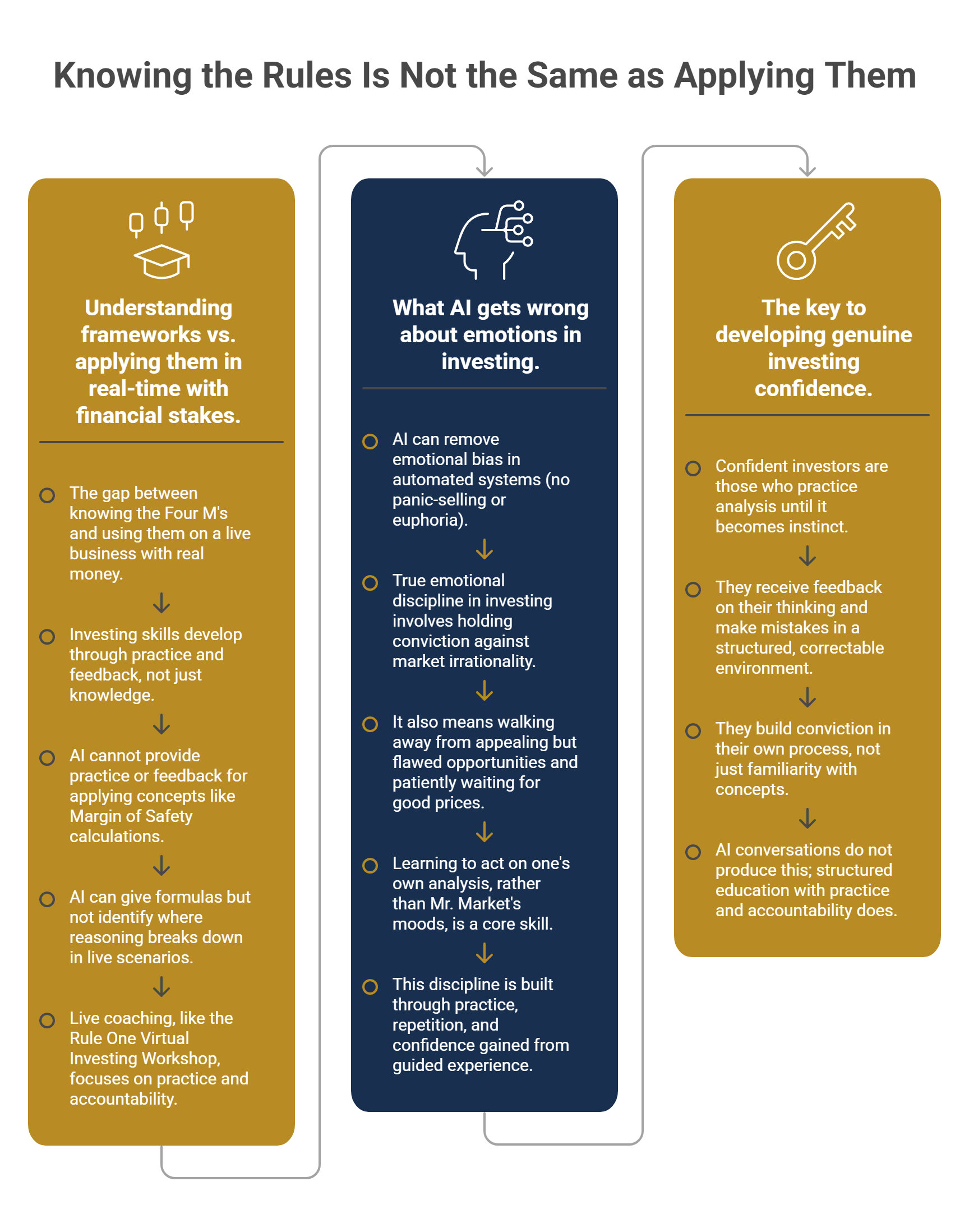
There is a real gap between understanding the Four M's framework and using it on a live business, with real money at stake, when your analysis is being challenged and the market is moving against you.
This is not a critique of the learner. It is how investing skills develop. Knowledge alone does not produce action. Practice and feedback do. And AI cannot provide either.
AI cannot watch you work through a Margin of Safety calculation on a live stock, see where your reasoning breaks down, and correct you before you make an expensive mistake. It can give you the formula. It cannot tell you where you went wrong.
Live coaching does exactly that. The Rule One Virtual Investing Workshop is built around practice, not passive learning.
What AI Gets Wrong About Emotions
AI is frequently promoted as a way to remove emotional bias from investing decisions. Automated systems do not panic-sell in a downturn, and they do not get swept up in excitement. In that sense, the claim is fair.
But the emotional discipline that investing actually requires is different. It shows up in moments like these:
Holding conviction in your own analysis when Mr. Market is pricing a business like it is worthless.
Walking away from something that fails the Four M's, even when it feels exciting.
Sitting patiently on your Watch List for months because nothing on it has reached a genuine Margin of Safety price yet.
Mr. Market is irrational. Some days, he prices a wonderful business below what it is worth because he is frightened. Other days, he prices it above its value because he is euphoric. Learning to act on your own analysis, rather than his mood, is one of the core skills a Rule One investor builds.
That discipline is not automated away. It is built through practice, repetition, and the kind of confidence that only comes from doing the work under guidance.
I have watched a lot of students come through this material. The ones who go on to invest with real confidence are not the ones who read the most.
They are the ones who:
Practiced the analysis repeatedly until it became instinct.
Got feedback on where their thinking was off.
Made mistakes in a structured environment where those mistakes could be caught and corrected.
Built genuine conviction in their own process, not just familiarity with the concepts.
No AI conversation produces that. Structured education, with practice and accountability, does.
The Accountability Gap
Here is something I have seen play out with students again and again.
People start with real intention. They dig in, they make progress, and then life takes over and the material just sits there. Not because they were not capable. Because learning on your own has no structure that demands you keep going.
AI has the same problem, and then some. It responds when you ask. It goes quiet when you stop. There is no one on the other side holding you to the goals you started with.
More information does not close that gap. Accountability does.
The Rule One Community Is Part of the Product
The Rule One Virtual Investing Workshop puts you in a room with other students working through the same analysis, at the same time, with coaches who can spot where your thinking breaks down and help you fix it.
That combination changes things in ways solo learning cannot:
When you test your read on a business against someone who reached a different conclusion, you find out fast where your reasoning holds up.
When a coach catches an assumption you did not know you were making, you learn something no article could have surfaced.
Investing is not a solo activity. The people around you, and the coaches guiding them, are part of how you get good at it.
Questions Investors Are Asking About AI and Investing
Can AI Predict Stock Market Crashes?
No. AI models are trained on historical data and cannot anticipate events that have never happened before.
Rule One does not try to predict crashes either. The Margin of Safety handles that, when you buy a wonderful business well below its actual value, you are protected if things go wrong in ways no one saw coming.
Is AI Stock Trading Suitable for Beginners?
AI-assisted tools like robo-advisors can manage a portfolio based on general criteria. What ai stock trading tools cannot do is teach beginners how to evaluate the businesses inside that portfolio or build the judgment to manage their own investments over time.
Self-directed investing with AI gets you a managed account. It does not get you the skills to understand what you own and why.
Can AI Replace a Financial Advisor or Investing Education?
For basic portfolio automation, AI tools can perform some of what a generic advisor does. For developing the ability to analyze a business, determine its value, and act on your own analysis with confidence, no AI tool currently does that.
That is what investing education, done well, is built to produce.
So, Can AI Teach You to Invest?
Here is the honest answer.
AI can expose you to investing concepts, help with research, and serve as a useful tool in a prepared investor's process. If your goal is to understand what a P/E ratio means, it is fine for that.
If your goal is to evaluate a real business, calculate a Sticker Price, identify a genuine Margin of Safety, and act on your own analysis with real money, that is a different thing entirely. It requires judgment, and judgment is built through practice, not queries.
Ready to Go Further?
If you are serious about learning to invest well, the workshop is where I would point you.
Here is what it looks like:
Three days, hands-on. You work through the Four M's on real companies, practice calculating Sticker Prices and Margin of Safety, and do it with live Rule One coaches who can see your work and correct your thinking in real time.
No selling. It is 100% education. Nothing else.
Built for people who want to do this themselves. Not a passive course. Not a webinar you half-watch. A structured program designed to close the gap between knowing the rules and being able to act on them.
Not quite ready? Start with our guide on how to invest in stocks. It will give you the foundation before you step into a live practice environment.
The Rule One Virtual Investing Workshop for $97. Show up ready to learn, and I will make sure you know what you are doing.
Rule One Investing provides investment education and training only. We do not provide personalized investment advice, manage client assets, or guarantee investment returns. All content is for informational purposes. Consult a qualified financial professional before investing. Past performance does not guarantee future results. Individual results vary.

Phil Town
Phil Town is an investment advisor, hedge fund manager, 3x NY Times Best-Selling Author, ex-Grand Canyon river guide, and former Lieutenant in the US Army Special Forces.