










Warren Buffett on Diversification: How to Build a Portfolio the Buffett Way
 Phil Town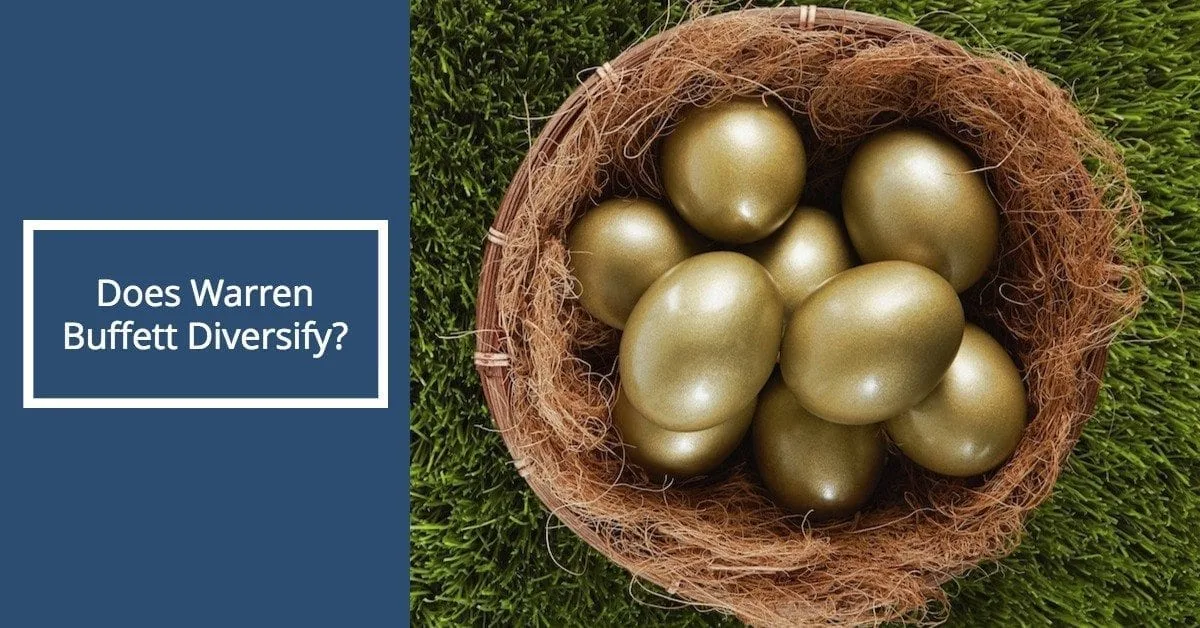
Warren Buffett famously said: "Diversification is protection against ignorance. It makes little sense if you know what you are doing."
You've probably heard from long-term investors and financial advisors that diversification, spreading your investments across different asset classes, is the cornerstone of a resilient portfolio. One day the market's soaring, the next it's taking a nosedive, and suddenly you're second-guessing every decision you've ever made.
But here's where I break from the crowd. At Rule #1, I don't view diversification the same way most of the industry does. I believe true risk management comes from knowing what you own and why, not from spreading your money across hundreds of assets you barely understand.
For me, diversification isn't about owning a little bit of everything. It's about building a focused portfolio of a few great businesses you understand deeply. Even legendary investors like Warren Buffett recognize that diversification has its place, especially for those who want to manage risk without obsessing over every market move.
In this article I'll clarify what Warren Buffett's diversification strategy really means from the Rule #1 perspective and show you how to apply these principles to your investment strategy.
[r1-cta-banner handle=“investors-survival-guide”]
The Benefits of Diversification According to Buffett
So why does diversification matter? You can't eliminate risk entirely. But you can manage it thoughtfully, and that starts with understanding what Buffett actually means when he talks about it.
Buffett does not dismiss diversification. He qualifies it. For investors who do not have the time or interest to evaluate individual businesses deeply, broad diversification makes sense:
It limits how much any one bad pick can hurt you
It gives you market-average returns without requiring deep research
It is a reasonable starting point while you build your investing knowledge
But it is a conditional recommendation, not a universal one. The legendary investor tells the average person to use index funds, yet Berkshire Hathaway itself holds approximately 68 percent of its equity portfolio in just five companies. That is not a contradiction. It is a conditional statement about knowledge.
And with the right strategy, you can invest with more confidence, knowing you have built a portfolio that is designed to stand the test of time. The difference is building that confidence through knowledge, not through spreading thin.
Warren Buffett's Investment Strategy: The "Generals"
Back in 1962, Buffett was already beating the stock market while taking on less risk than most. In his partnership letter that year, he outlined his approach, which he called "The Generals."
Here's how he put it:
"We usually have fairly large portions (5% to 10% of our total assets) in each of five or six generals, with smaller positions in another ten or fifteen."
In plain terms, he put about half his money into five or six stocks, with smaller positions beyond that. He picked these stocks because they were cheap and each one carried a built-in margin of safety. He was not looking for flashy companies. He was buying when nobody else wanted these stocks.
As he said:
"It is difficult at the time of purchase to know any compelling reason why they should appreciate in price. However... they are available at very cheap prices. A lot of value can be obtained for the price paid. This substantial excess of value creates a comfortable margin of safety in each transaction."
And he was always honest about the downside:
"Just because something is cheap does not mean it is not going to go down. During abrupt downward movements in the market [these stocks] may very well go down percentage-wise just as much as the Dow…."
By 1965 Buffett had sharpened this even further. He added a new Ground Rule to his partnership stating:
"We might invest up to 40% of our net worth in a single security under conditions coupling an extremely high probability that our facts and reasoning are correct."
That is not recklessness. That is conviction backed by deep research.
A real example of this in practice: in the early 1960s Buffett invested a significant portion of his portfolio in American Express after a scandal caused the stock to plummet. He recognized that the underlying business was sound and the damage was temporary. That concentrated bet paid off enormously. It was not a gamble. It was the result of knowing the business deeply enough to act when everyone else was running.
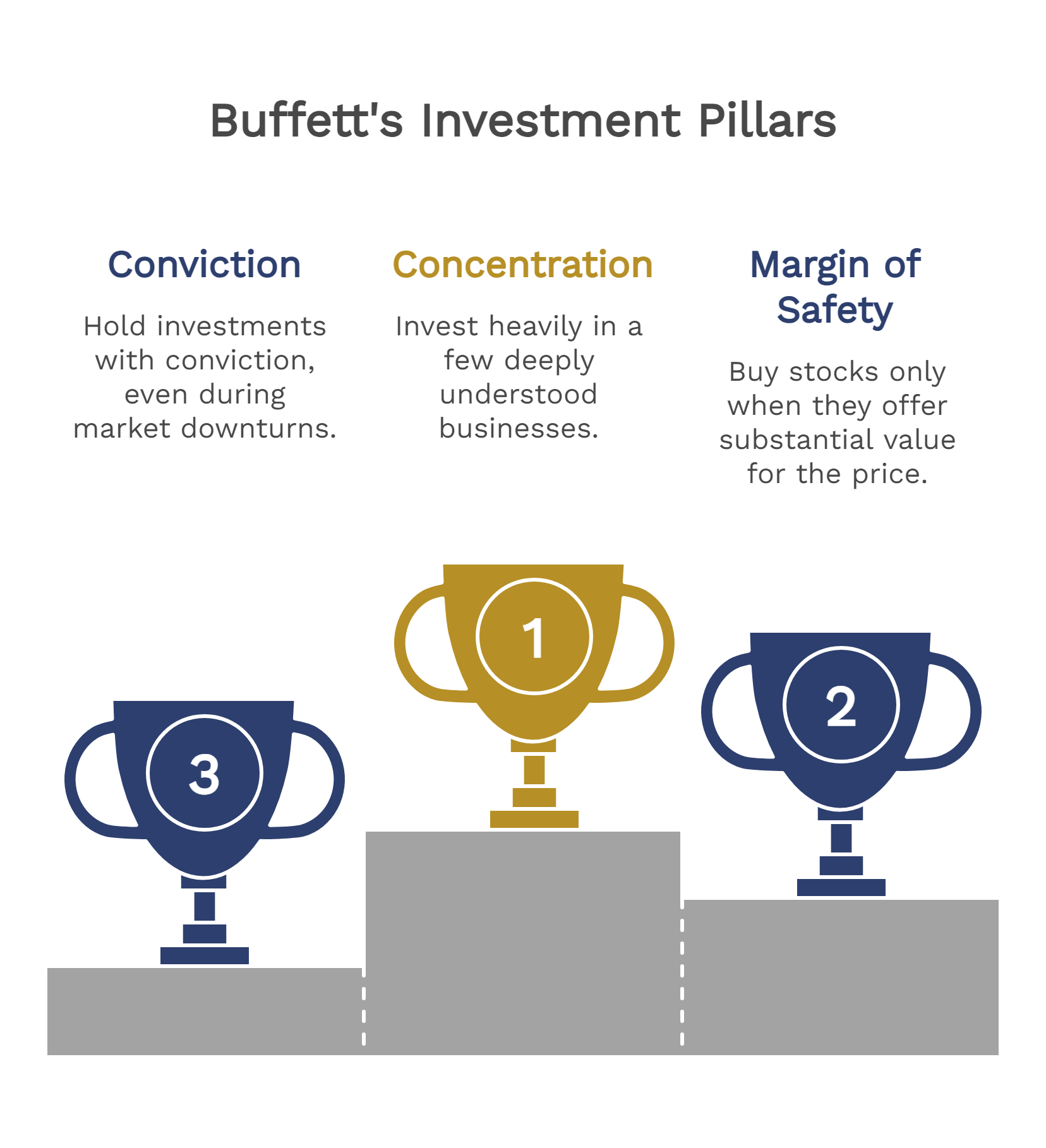
That logic did not stay in 1962. It is the same approach Rule #1 investors use today: concentrate in a handful of businesses you understand deeply, buy only when the price gives you a real Margin of Safety, and hold with conviction.
The Four M's framework is how I put that into practice.
Buffett's Take on Diversification: Focus, Not Over-Diversification
Now, here's where Buffett's views on diversification get interesting. He believes in diversification, but not the way most mutual funds do it. In his words:
"Combining this individual margin of safety, coupled with a diversity of commitments creates a most attractive package of safety and appreciation potential."
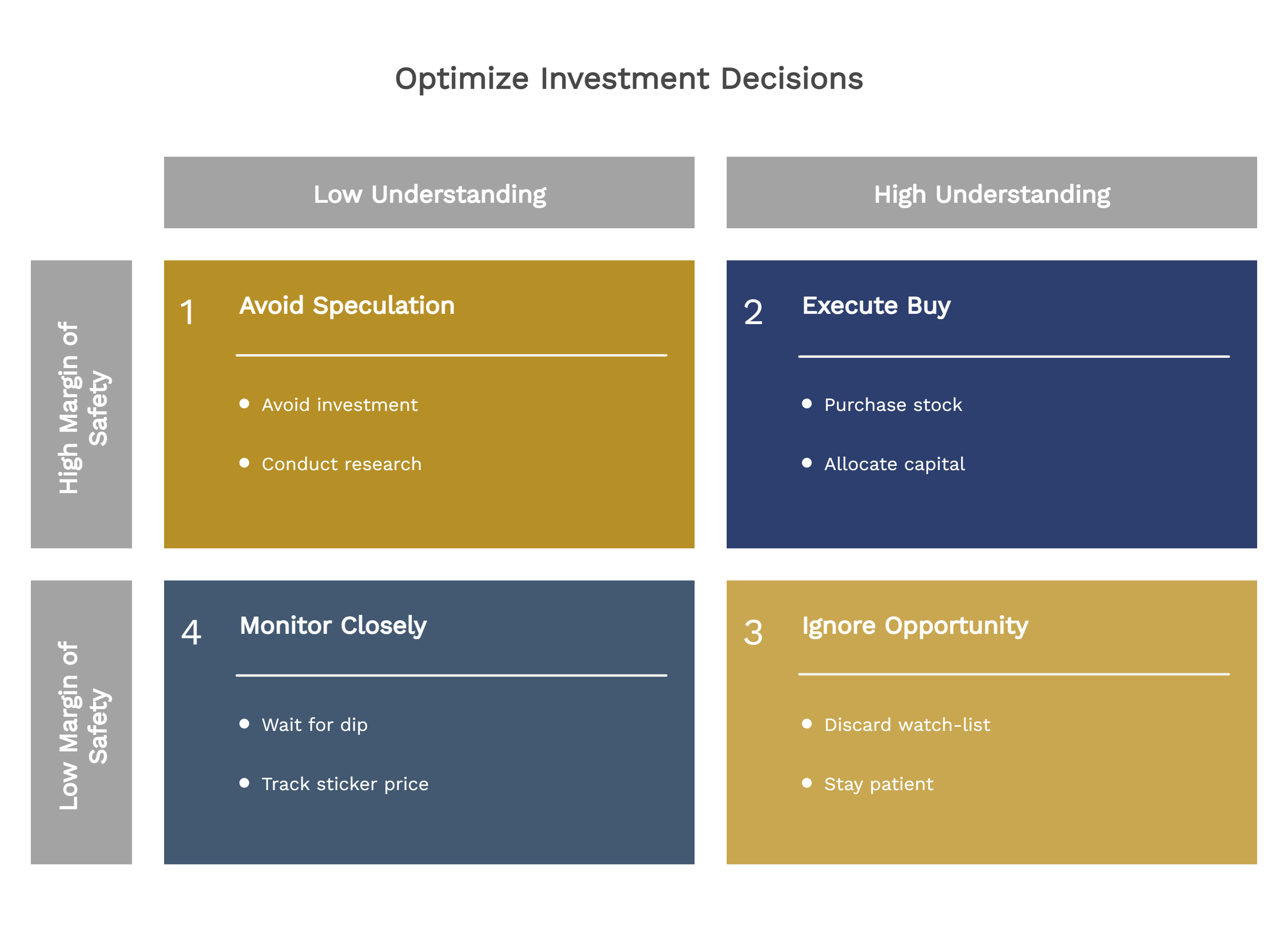
The key word there is individual margin of safety. He is not talking about spreading money thin for the sake of it. He is talking about owning a focused set of positions, each one purchased at a price that already protects you on the downside.
By today's standards, Buffett's portfolio would look pretty focused. Fifty percent in five stocks? Most financial advisors would call that under-diversified. But Buffett thinks owning too many stocks, what he calls over-diversification, can actually hurt your returns, especially after fees.
His philosophy? Focus your money on a handful of great companies that you really understand and believe in. That's how you beat the market. That is exactly what his famous quote means in practice.
This highlights his belief that a focused portfolio of well-understood, high-quality businesses can be less risky than a broadly diversified one.
The Problem With Over-Diversification
Over-diversification does not eliminate risk. It just makes it harder to see. When you spread capital across 50 stocks you have not properly evaluated, you have not made your portfolio safer. You have just hidden the danger from yourself.
Peter Lynch had a word for this: "deworsification." Spreading money across so many mediocre positions that no single great business can move the needle, while the weak ones still can hurt you.
Buffett made this point even more bluntly. In his 1984 shareholder letter he wrote: "If you have a harem of forty women, you never get to know any of them very well." The same logic applies to stocks. Spreading too thin destroys the depth of understanding that makes concentrated investing safe.
His 1993 shareholder letter went further:
"If you are a know-something investor, able to understand business economics and to find five to ten sensibly-priced companies that possess important long-term competitive advantages, conventional diversification makes no sense for you. It is apt simply to hurt your results and increase your risk."
Why Concentrated Investing Is Actually Less Risky
There is also a point most people miss about risk itself. Buffett rejects the way Wall Street measures risk. Academics use beta, a metric that tracks how much a stock's price moves relative to the market. But Buffett argues this misses the point entirely. Real risk is not price volatility. Real risk is the chance of permanently losing money because you did not understand what you were buying.
A business bought at a significant discount to its true value is less risky than one bought at full price, regardless of what its beta says. Buffett proved this with The Washington Post in 1973. When the stock plunged, Wall Street called it riskier. Buffett bought more. He recognized the underlying business was sound and the price was a gift. That is the Rule #1 definition of risk in action.
Here is something else worth knowing. Fund managers diversify the way they do because they have to. They are managing redemption risk, career risk, and quarterly benchmarks. Those are institutional constraints. You do not have them. That is an advantage most individual investors never think to use.
Charlie Munger, Buffett's longtime partner, shared the same view: find a few great businesses, understand them deeply, and concentrate there. Broad diversification was never part of how they built one of the most successful investment records in history.
A Look at Berkshire Hathaway's Portfolio
Let's bring this into the present. As of Q1 2026, Berkshire Hathaway's portfolio tells a clear story about what focused investing actually looks like. The top five holdings are:
Apple Inc. (AAPL): 21.99% of the portfolio
American Express Co. (AXP): 17.43%
Coca-Cola Co. (KO): 11.56%
Bank of America Corp. (BAC): 9.52%
Chevron Corp. (CVX): 6.64%
These five positions represent approximately 68% of Berkshire's total equity portfolio across just 29 total holdings. That is not a flaw in the strategy. That is the strategy.
As of Q1 2026, Berkshire holds $397.4 billion in cash and equivalents, more than half of the company's total investable assets. Buffett is not always in the market. When no business meets his criteria, he waits. That is not passivity. That is discipline.
For a Rule #1 investor, that lesson is just as valuable as knowing which businesses to buy.
Read more of Buffett's thoughts in his own words here.
Building Your Own Diversification Strategy
So what does that process actually look like? The difference between Buffett's concentration and a gambler's concentration is discipline.
Buffett does not buy businesses on instinct or excitement. He buys them after doing the work. That is the part most people skip.
Start With the Four M's
The Four M's eliminate ignorance before you commit capital. That is exactly what Buffett's quote calls for.
Meaning: Do you understand this business well enough to own it? If you cannot explain what it does and why it wins, you are not ready to buy it. This is what Buffett calls your circle of competence: investing only in businesses you truly understand.
Moat: Does the business have a durable competitive advantage that protects it from competitors? A great moat is what makes future earnings predictable.
Management: Are the people running this business honest, owner-oriented, and thinking long-term? You want managers who treat the business like it is the only asset their family will own for the next 100 years.
Margin of Safety: Is the price low enough to protect you if something goes wrong? You never pay full value. You wait for the business to go on sale.
Confirm the Moat With the Big Five Numbers
Once the business passes all four M's, the Big Five Numbers confirm the moat is real and has been real for at least ten years. All five should be growing at 10 percent or more per year over the last decade:
Return on Invested Capital (ROIC)
Sales growth
Earnings Per Share (EPS) growth
Equity growth
Free Cash Flow growth
Consistent numbers mean a durable business. Inconsistent numbers mean you are buying a story, not a moat.
Buy at the Right Price
Then you calculate the Sticker Price to find out what the business is worth. And you wait for Mr. Market to offer it to you at a Margin of Safety, 50 percent off the Sticker Price.
That is when you buy. Not when the business looks exciting. Not when everyone else is buying. When the price is right.
When Nothing Qualifies, Wait
If nothing on your Watch List meets those criteria, you hold cash and wait. That is not a failure. That is exactly what the legendary investor does with $397 billion in cash.
Buffett said it himself in his 1993 letter: in an investment lifetime, it is just too hard to make hundreds of smart decisions. Their goal was one good idea a year. That patience is not weakness. It is the edge that individual investors have over every institution on Wall Street.
Use the Rule #1 Investment Calculators to start running these numbers today.
Common Questions and Misunderstandings
It's normal to have questions about how Buffett's views on diversification actually apply to you. Here are the ones I hear most often.
What does "diversification is protection against ignorance" actually mean?
It means that spreading money across many positions is a way of managing the risk of not knowing what you own. If you eliminate that ignorance through real research, the need for that kind of protection changes. That is the whole point of learning to evaluate businesses properly.
Does Warren Buffett believe in diversification?
Yes, but conditionally. Diversification is the right tool for investors who lack the time or knowledge to evaluate individual businesses. For investors who have done the work, concentration in a few great businesses makes more sense. His position is not anti-diversification. It is anti-ignorance.
What is Warren Buffett's actual diversification strategy?
Buffett concentrates his portfolio in a small number of businesses he understands deeply and has held patiently for decades. As of Q1 2026, the top five holdings in Berkshire Hathaway represent approximately 68 percent of the total equity portfolio. That is not accidental. It is the result of decades of disciplined, focused investing.
Is Berkshire Hathaway's portfolio diversified?
Not in the conventional sense. The top five holdings make up the majority of the portfolio across just 29 total positions. That is not broad diversification. It is deliberate concentration built on deep knowledge and patience.
What is deworsification and why does it matter?
It is a term Peter Lynch used to describe a portfolio so broad it becomes a collection of mediocre ideas rather than a group of wonderful businesses. When your winners represent 1 or 2 percent of your portfolio, they cannot move the needle. But your losers still can.
Should I copy Buffett's portfolio?
No. Never buy a business just because someone else owns it. Some positions in any portfolio involve strategies that are not visible in a public filing and may no longer offer a Margin of Safety at today's prices. Run every business through the Four M's yourself. If it passes and the price is right, buy it. If it does not, keep looking.
What does Buffett recommend for the average investor?
For investors who do not want to learn to evaluate individual businesses, low-cost index funds are a reasonable starting point. But they are a starting point, not a ceiling. Anyone willing to learn the Four M's and apply them with discipline has more options available. That is exactly what Rule #1 is built to help you do.
How is concentrated investing different from just taking on more risk?
Conventional investing equates concentration with risk but Buffett disagrees. Real risk is the permanent loss of capital that comes from not understanding what you own. When you know a business deeply and buy it at a significant discount to its true value, concentration is not reckless. It is discipline.
Final Thoughts
Investing doesn't have to be overwhelming. Whether you're new to the game or a seasoned pro, understanding Warren Buffett's approach to diversification can help you build a portfolio that stands the test of time.
Buffett is not anti-diversification. He is anti-ignorance. That one distinction changes everything about how you build a portfolio.
It is not about chasing the latest trend or owning a hundred different stocks. It is about making thoughtful choices through a repeatable process. The Four M's, the Big Five Numbers, the Sticker Price, the Margin of Safety. That is the process.
It is the same logic Buffett has applied for decades. And it is exactly what I teach at the Rule #1 Virtual Investing Workshop.
If you are ready to stop guessing and start evaluating businesses the right way, I would love to see you there.
Register for the Virtual Investing Workshop today.
Disclaimer: This article is for informational purposes only and does not constitute financial advice. Always do your own research or consult a financial advisor before making investment decisions.
[r1-cta-banner handle=“virtual-investing-workshop”]
Phil Town
Phil Town is an investment advisor, hedge fund manager, 3x NY Times Best-Selling Author, ex-Grand Canyon river guide, and former Lieutenant in the US Army Special Forces.