












Own Lululemon Stock? What the Proxy Fight Means for You
 Phil Town
I've spent decades looking at businesses the way an owner does, not the way a spectator does. So when the Lululemon proxy fight started making headlines, it troubled me to see so many investors treat it as background noise.
If you hold lululemon stock, whether you own it directly or through a broad-market ETF, you're a part owner of that business, and what happens in that boardroom is your business too. That is not a figure of speech. It is the literal legal reality of what it means to own a stock.
The proxy fight was a reminder that shareholders have real power, and learning how to invest like an owner begins with understanding when and how to use it.
https://www.youtube.com/embed/Y7iKWrHjnG4?si=njxHXYnor7vOcnOE
What a Proxy Fight Actually Is
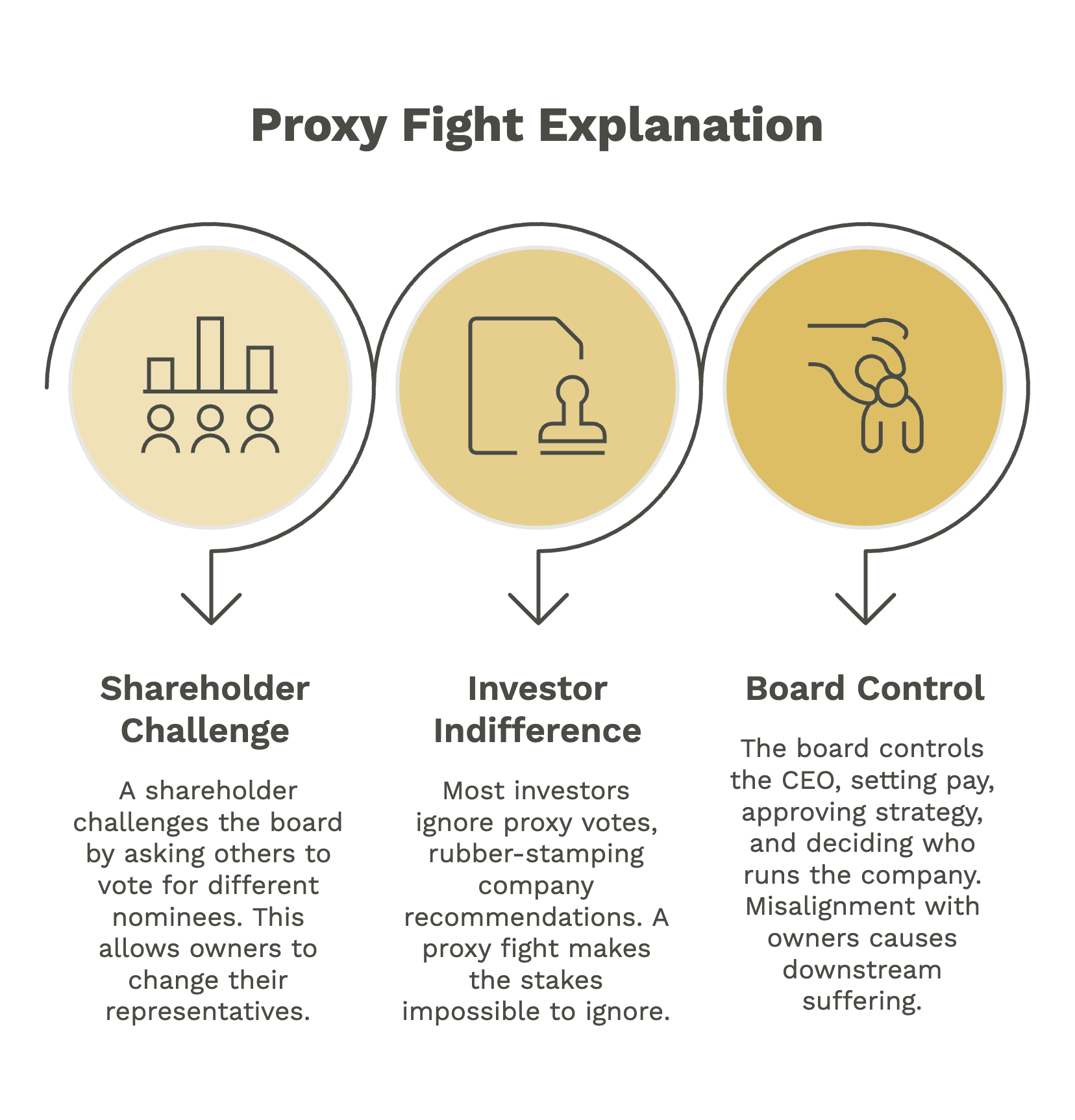
So what is a proxy fight, exactly? It is when a shareholder challenges the existing board of directors by asking other shareholders to vote their shares for a different slate of nominees. In plain English, it is how the owners of a company can change who represents them. You might think of it as democracy for shareholders.
Most investors never give proxy votes a second thought. They set the mailing aside, or they rubber-stamp whatever the company recommends. A proxy fight makes the stakes impossible to ignore, because someone, sometimes a small activist fund and sometimes a founder with a large stake, has decided the people running the board are not acting in the owners' interest. So they gather votes to replace them.
Here is why that matters to you. The board controls the CEO. It sets the pay, approves the strategy, and decides who runs the company. When the board is misaligned with owners, everything downstream suffers. That is why shareholder voting rights matter, even if you own only a few shares.
Chip Wilson's Eight-Year Warning About Lululemon
Chip Wilson founded Lululemon in 1998, and he is still one of lululemon's largest individual shareholders. He has been publicly criticizing the direction of the company since around 2018, including in his book Little Black Stretchy Pants, where his warning was simple: the board was prioritizing quarterly earnings over the company's product DNA.
A Specific Diagnosis, Not a Vague Complaint
That is not a vague complaint. It is a specific diagnosis. A board focused on short-term metrics can coast on an existing advantage for years while quietly letting the underlying product edge erode. Lululemon invented the modern athleisure category, but competitors caught up while the company kept milking that original lead instead of extending it.
What the Numbers Show
The numbers tell the story. According to Wilson's materials:
Lululemon lost approximately $17 billion in shareholder value over five years
It posted eight consecutive quarters of flat or declining Americas same-store sales
The stock dropped roughly 38 percent in 2024 alone
Three separate CEO succession processes failed to produce a stable, product-aligned leader
That is not a run of bad luck. It is a structural problem.
My Honest Read
Here is my honest read: Chip Wilson has been right. When a company loses its product DNA and its technological edge, the premium margins follow it out the door. Then the premium price goes, and then the stock goes. That is exactly the sequence we watched unfold.
The Board Ownership Problem: When Directors Don't Share Your Pain
What Warren Buffett Has Long Argued About Boards
Warren Buffett, the legendary investor, has spent decades making one specific, well-documented argument about public company boards, and here is how I have come to summarize it. Most boards are not made up of owners.
They are made up of directors who collect sizeable fees, enjoy the perks, and hold stock that is small relative to their net worth, which means their personal outcome is largely disconnected from what happens to long-term shareholders.
Buffett's reasoning on this is worth reading in full.
What the Lululemon Proxy Reveals
Pull up the Lululemon proxy and look at the beneficial ownership tables. What you'll find is that several directors sit at or near the company's own minimum ownership requirement, and some sit below it, despite long tenures on the board. So when the stock fell roughly 38 percent in a single year, their personal pain was small next to what everyday shareholders absorbed.
The Point Is Structural, Not Personal
This is not a personal attack on any director. The point is structural. When the board does not share your pain in a decline, it doesn't share your urgency about fixing it, and urgency is exactly what this company needed years ago.
My Ownership Test: A Question Worth Asking About Any Board
There is one question I come back to every time I evaluate a board, whether it is Lululemon or any other company:
"If you owned the whole business, would today's board be the board that you would want to represent you for the next 10 years?"
Ask it slowly. It cuts through the polished bios, the committee memberships, and the independence checkboxes, and it gets to the only thing that really matters: are these the right people to protect your interest over the next decade?
Underneath that question sits a principle that frames everything else I believe about corporate governance:
"Boards work for owners. They're not the owners, they are the owners' representatives."
When representatives forget who they work for, when they shield each other from criticism and insulate themselves from the consequences of poor decisions, the long-term value of the company suffers. It has always worked that way.
The Apple and Steve Jobs Parallel: Why Brand DNA Matters to Lululemon Stock
How Apple Lost Its Way Without Its Founder
I keep coming back to the Apple story because it fits so well. In 1985, Apple's board pushed Steve Jobs out of the company he built. The official reason was strategic disagreement, but the real reason was simpler: a young founder kept telling the board it was wrong, and the board had stopped wanting to hear it.
What happened next became one of the great cautionary tales in business. For about a decade, Apple cycled through CEOs, watered down its products, and lost the identity that made it special, and the company nearly went bankrupt.
Then Jobs returned in 1997, and the DNA returned with him. A few years later came the iMac, the iPod, and the iPhone, and Apple grew into the most valuable consumer business in history.
Why the Board, Not Just the CEO, Holds the DNA
That is the kind of turnaround Lululemon needs, and the Four M's framework helps explain why. The Management M is not only about the CEO. It includes the board that hires and oversees the CEO, because a board without brand and product expertise cannot tell whether a CEO is protecting the company's core identity or simply hitting quarterly targets.
The Settlement: An Early "DNA Coming Back" Signal
Here is the part worth knowing. In late May 2026, the proxy fight resolved through a cooperation agreement, and the board agreed to seat two of Wilson's nominees after the 2026 annual meeting:
Marc Maurer, former co-CEO of On, the Swiss running shoe company
Laura Gentile, former CMO of ESPN
A third independent director with apparel expertise will follow by October 1, 2026. Eric Hirshberg, the former CEO of Activision Publishing who was also nominated by Wilson, is not among the two being seated.
Is that a full turnaround? Not yet, and I am not predicting outcomes. But founder-aligned, brand-and-product-focused directors joining the board is exactly the kind of structural change the Apple story points to.
It is worth noting that incoming CEO Heidi O'Neill inherits a board that now includes founder-aligned directors. You can read that as an early sign that the DNA may be coming back, which is worth noting for your lululemon stock analysis.
Chip Wilson's Proof of Concept: Amer Sports
The Amer Sports Playbook
Here is what you really need to understand about Chip Wilson: he has already run this experiment somewhere else. Amer Sports is a collected-brands company, home to Wilson, Arc'teryx, and Salomon. Chip owns roughly 18 percent of Amer Sports, about 21 percent at the 2024 IPO and trimmed to 18 percent by an August 2025 SEC filing.
After Amer acquired each brand, he created a brand product committee to help those brands recover their identity and momentum. The thesis is simple: protect the brand DNA after an acquisition, and the business grows stronger.
One data point from that track record is worth mentioning. Amer stock has outperformed the S&P 500 by almost double since the 2024 IPO. That is a fact about Amer's record, not a promise about anyone's future return.
What Wilson Proposed for Lululemon
On May 6, Wilson sent a letter to the Lululemon board proposing that same brand-product-committee structure for Lululemon. It was a focused, sensible plan backed by real results. By Wilson's account, the board's concrete response was a request that he sign a non-disparagement agreement and stop publicly criticizing the company. The later settlement did include a mutual non-disparagement provision, so that standoff is resolved now, but the board's initial response to a substantive proposal with documented proof behind it tells you something about where its priorities were.
How Shareholder Voting Works: What the Lululemon Proxy Fight Teaches Every Investor
The contest settled before it ever reached a shareholder vote, so I want to use it as a clean, evergreen lesson rather than a call to action. The mechanics here matter for any contested election you may face as an owner.
The Three Mechanics Every Owner Should Know
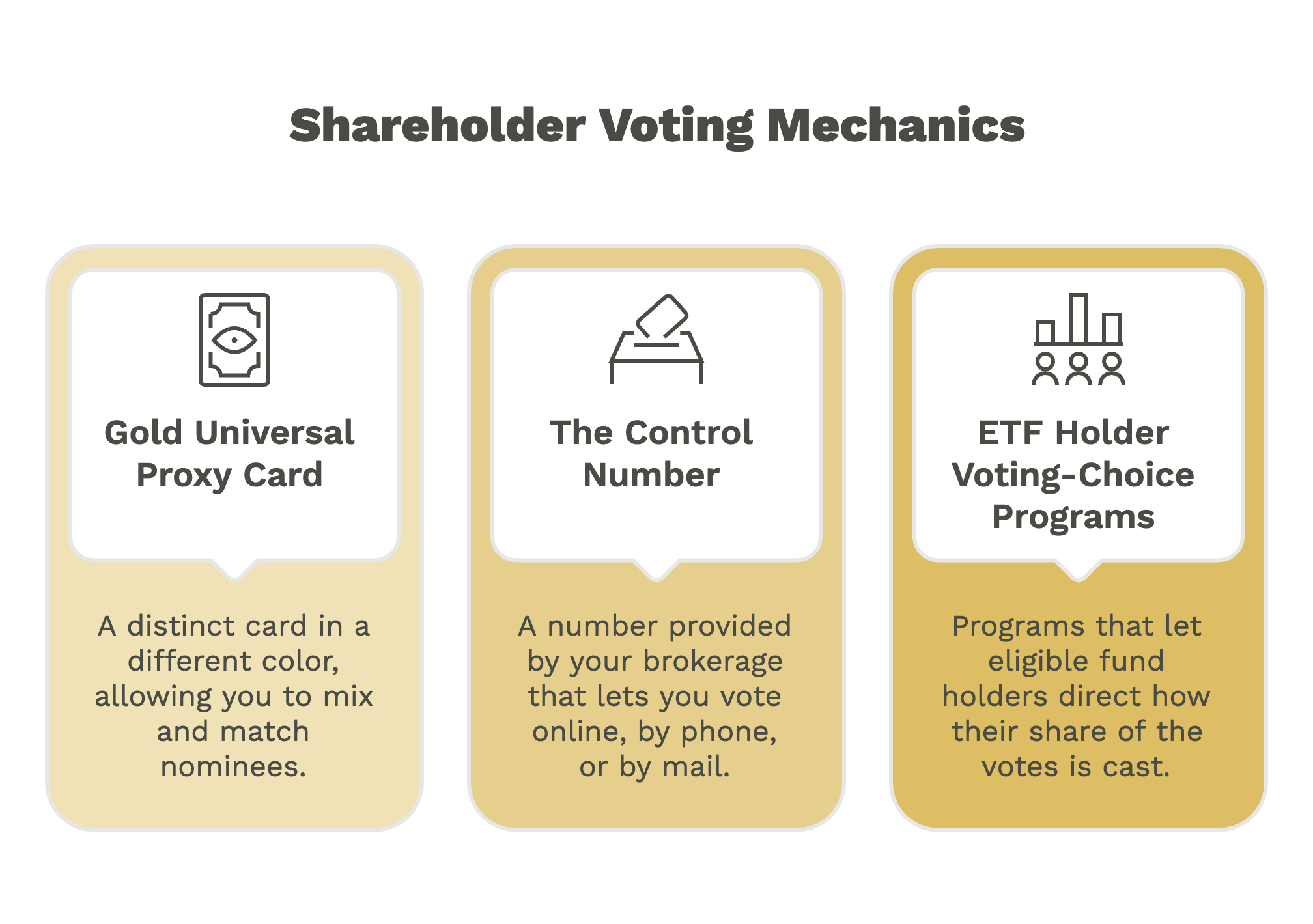
Knowing how to vote your shares comes down to three things:
The gold universal proxy card In a contested election, the challenger usually issues a distinct card in a different color, which in this case was gold. You choose which nominees to support, whether that is the challenger's slate, the company's slate, or a combination, and universal proxy rules now let you mix and match nominees from both slates on a single card.
The control number If you hold shares directly, your brokerage gives you a control number that lets you vote online, by phone, or by mail. That number ties your specific shares to the vote, so call your broker if you aren't sure where to find it.
ETF holder voting-choice programs If you own Lululemon through a broad-market fund or ETF, Vanguard offers a program called Investor Choice, BlackRock has Voting Choice, and Fidelity has run a pilot. These programs let eligible fund holders direct how their share of the votes is cast rather than leaving the decision to the fund manager.
Why This Matters Beyond Lululemon
This reaches well beyond Lululemon. Every major company you own through a fund faces contested votes, executive pay packages, and governance proposals, and as an owner you're entitled to participate. Most investors never do, and that is a missed opportunity.
Where I Stood During the Contest
My own position during the contest was straightforward. I sided with the founder and the push for genuine brand and product expertise on the board, because a board without people who deeply understand the product cannot judge whether management is protecting what made the business worth owning in the first place.
Applying Rule #1's Management Framework to Lululemon Stock Analysis
The Management M of the Four M's asks three specific questions about the people running a company.
The Three Questions I Ask About Management
Here is the practical checklist I use when I apply it to lululemon stock analysis:
Skin in the game Do the directors own enough stock that a year like 2024 hurts them the way it hurt ordinary shareholders? As I mentioned earlier, the ownership tables suggest the answer is no for several of them, despite long tenures.
Honesty with shareholders Has management been straightforward about the competitive threat from newer athleisure brands, about the succession failures, and about why three CEO searches produced so much instability?
Product passion versus short-term metrics Are the big decisions driven by an obsession with making the best product in the category, or by hitting the next quarter's number?
It's All the Same Homework
None of this requires a finance degree. It asks you to read the annual report, listen to the earnings calls, and consider one question: are the people in charge running this company as if it were the only asset they would own for the next 100 years?
That is what Rule #1 investors do. We buy businesses rather than just buying stocks, and that reframes how to evaluate a company's management entirely. It is not a separate box to tick; it is part of the same homework as the numbers, which is exactly why Rule #1 investors buy businesses instead of just picking stocks.
Is Lululemon a Good Stock to Buy? The Right Question to Ask
If you typed "is lululemon a good stock to buy" into a search bar, you were probably hoping for a price target and a yes or no. I am not going to give you that. What I will give you is a framework, because the honest answer depends entirely on the homework you're willing to do.
The Questions That Actually Matter
The right question is not whether the stock is cheap. The right questions are these:
Is this a wonderful company?
Do I understand it?
Does management think like an owner?
Is the price below the Sticker Price, which is Rule #1's term for a company's intrinsic value, by a wide enough Margin of Safety to justify the risk?
What the Settlement Changes
Board composition may be improving. Two founder-aligned directors with real brand and product credentials are joining, and that is a structural positive.
What the Settlement Doesn't Change
It doesn't settle whether the brand DNA can actually be restored, whether the competitive gap has grown too wide to close, or whether the company can return to the growth that would justify a premium price. Those remain open questions.
So Lululemon may be a wonderful company that is on sale right now, or it may be a wonderful company whose best days depend on a turnaround that is far from guaranteed. The Margin of Safety calculation depends on the growth rate you believe is realistic over the next decade, and that calculation is yours to run.
Learn the Same Process I Used to Analyze Lululemon
The Lululemon proxy fight is a live demonstration of what owner-level investing actually looks like. If it made you want to run this same analysis on a company you already own, or one you're thinking about, that is exactly what I teach at the Rule #1 Virtual Investing Workshop.
We work through real businesses together with live coaching, so you can bring your own questions and work through your stumbling blocks as you go. I would be glad to have you join me there.
If you would rather start with the broader framework first, the Rule #1 stock investing guide walks through the whole process, from finding a wonderful business to deciding whether it is on sale.
Owning a share means owning a piece of a business. Once you start thinking that way, every board decision, every succession failure, and every proxy fight stops being background noise. It becomes your business.
Related Resources
If you want to go deeper on the numbers side, How to Evaluate a Company: 5 Key Financial Metrics for Smarter Investing covers the Big Five Numbers that pair naturally with the Management M work above.
This article is for educational purposes only. Nothing in this content constitutes personalized investment advice or a recommendation to buy or sell any security. Individual investment decisions should be made based on your own research and, where appropriate, consultation with a qualified financial professional.

Phil Town
Phil Town is an investment advisor, hedge fund manager, 3x NY Times Best-Selling Author, ex-Grand Canyon river guide, and former Lieutenant in the US Army Special Forces.